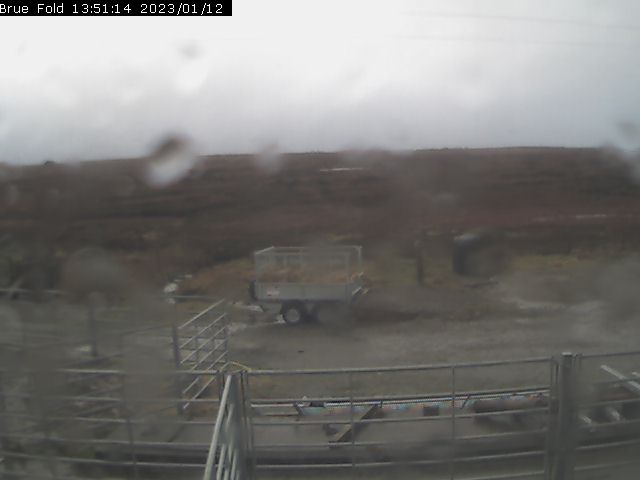
View from the cattle pens

The live webcam feed (above) updates a still image every 30 seconds to this internet page and currently shows the external view over the rear of the cattle shed pens - looking south and west over Brue Inner Grazings which is closed annually to all stock from mid-May to mid-August. There is one snag, this camera cannot see in the dark either!
Our Highland cattle normally calve in the Spring (March/April). This is an especially busy and enjoyable time on the croft with cattle calving and sheep lambing. In the Western Isles (Outer Hebrides), it is still a time of year when cattle and sheep are almost entirely dependent on their owner or stockperson for their care, feed and protection in harsh weather. It is also a time of late nights and dawn risings to keep an ever watchful eye on animals in the period leading up to, during and immediately after calving.
Of course it helps if you know the exact date each cow was at the bull the previous summer. Usually, a Highland cow will calve around 9 months and 9 days after being to the bull, with heifers (first-time calvers) tending to be a few days sooner.
Normally, Highland cattle will calve without any human help but, on occasion, the calving process can experience difficulties.
Should assistance be required, it is very important that experienced or veterinary help is summoned immediately in order to save the life of the calf and its mother.
Although calving in the open may be the natural and ideal method, calving inside offers a number of advantages while the addition of a webcam offers remote monitoring without disturbing the cattle that are about to calve.
By using modern webcam technology we are able to monitor the cattle in the byre where calving pens are available.
The natural instinct of the Highland cow is to move away and out of sight of other cattle just before calving and some cows will even jump fences and break open gates in order to get away from the herd. A calving cow will often find a quiet, secluded place where her newborn calf can be born away from the dangers of being trampled by the other cattle, or being attacked by predators. Then, after a day or so, it should, if required, be strong enough to walk alongside the protection of its mother.
However, although Highland cattle are generally good and protective mothers, the Hebridean spring weather can be a harsh time for outside calving with significant risks from heavy rain, wind chill, exposure and hypothermia which can quickly kill a struggling newborn calf in its first critical hours of life. In addition, there is the added natural danger of heavily pregnant cows getting bogged down in wet peatland and/or newly born calves drowning in drains, bogs, lochs and rivers.
Our experience has been that:
a) finding or guiding a Highland cow which is about to calve on a howling wet, dark night on a cold moor or even in an enclosed field is something best avoided;
b) we have lost a calf which was born outside in severe cold weather after its mother experienced a difficult calving, despite the best endeavours of veterinary staff;
c) so far, we have not lost a calf or cow which has calved within the controlled environment of a secure calving pen with ready access to a cattle holding (crush) facility.
Spring 2008 Calvings:
| Cow |
Due to calve on |
Actual calving date |
Calf details |
| Anna an Eilein of Brue (1 st calf) |
On/around 2 March 2008 |
25 March 2008 |
Male calf - see photograph |
| Sine a' Ghlinne of Brue (1 st calf) |
24 January 2008 |
29 January 2008 |
Heifer calf - see photograph |
| Una of Borve (5th calf) |
12 March 2008 |
8 March 2008 |
Heifer calf - see photograph |
| Seònaid 3rd of Crossnish (5th calf) |
13 March 2008 |
15 March 2008 |
Heifer calf - see photograph |
| Caileag Bheag 17th of Callachally (5th calf) |
25 March 2008 |
26 March 2008 |
Heifer calf - see photograph |
Spring 2007 Calvings:
| Cow |
Due to calve on |
Actual calving date |
Calf details |
| Seònaid 3rd of Crossnish (4th calf) |
Wednesday, 28 March 2007 |
Friday, 30 March 2007 |
Male calf - see photograph |
| Caileag Bheag 17th of Callachally (4th calf) |
Friday, 30 March 2007 |
Monday, 9 April 2007 |
Heifer calf - see photograph |
| Una of Borve (4th calf) |
Sunday, 15 April 2007 |
Thursday 19th April 2007 |
Male calf - see photograph |
Note: The Macaulay Land Use Research Institute through its ‘Macaulay Lewis Endowment Fund’ has provided assistance to ‘Brue Highlanders’ for exploring the use of internet and webcam technologies to support sustainable cattle production on Lewis. The Macaulay Institute is particularly keen to use these new technologies for educational purposes and for allowing school pupils to gain a better understanding of local food production systems and appreciate the important beneficial links between their land, island locality, local food produce and healthy, lifestyle choices.
If you would like to find out more about our Highland cattle or using webcam technologies or indeed Highland cattle in general, please feel free to email us with your queries or comments.
|